The 8-Bar Build That Makes Your Drops Hit Twice as Hard
 ReOrder
·May 6, 2026
·5 min read
ReOrder
·May 6, 2026
·5 min read
The drop isn’t where the magic happens in trance. The 8 bars before the drop is.
If your drops feel anticlimactic, if the energy doesn’t translate, if the listener’s not pumping their fist when the kick comes back — your drop is fine. Your build is broken.
I noticed this years ago listening back to my own tracks. The drop section was great in isolation. The breakdown was great in isolation. But the bridge between them — the 8 bars where everything is supposed to be screaming “GET READY” — was just a snare roll and a riser. Nothing else. No shape. No real tension.
So let’s have a look at how I structure the 8 bars now, and why every tiny detail in there matters.
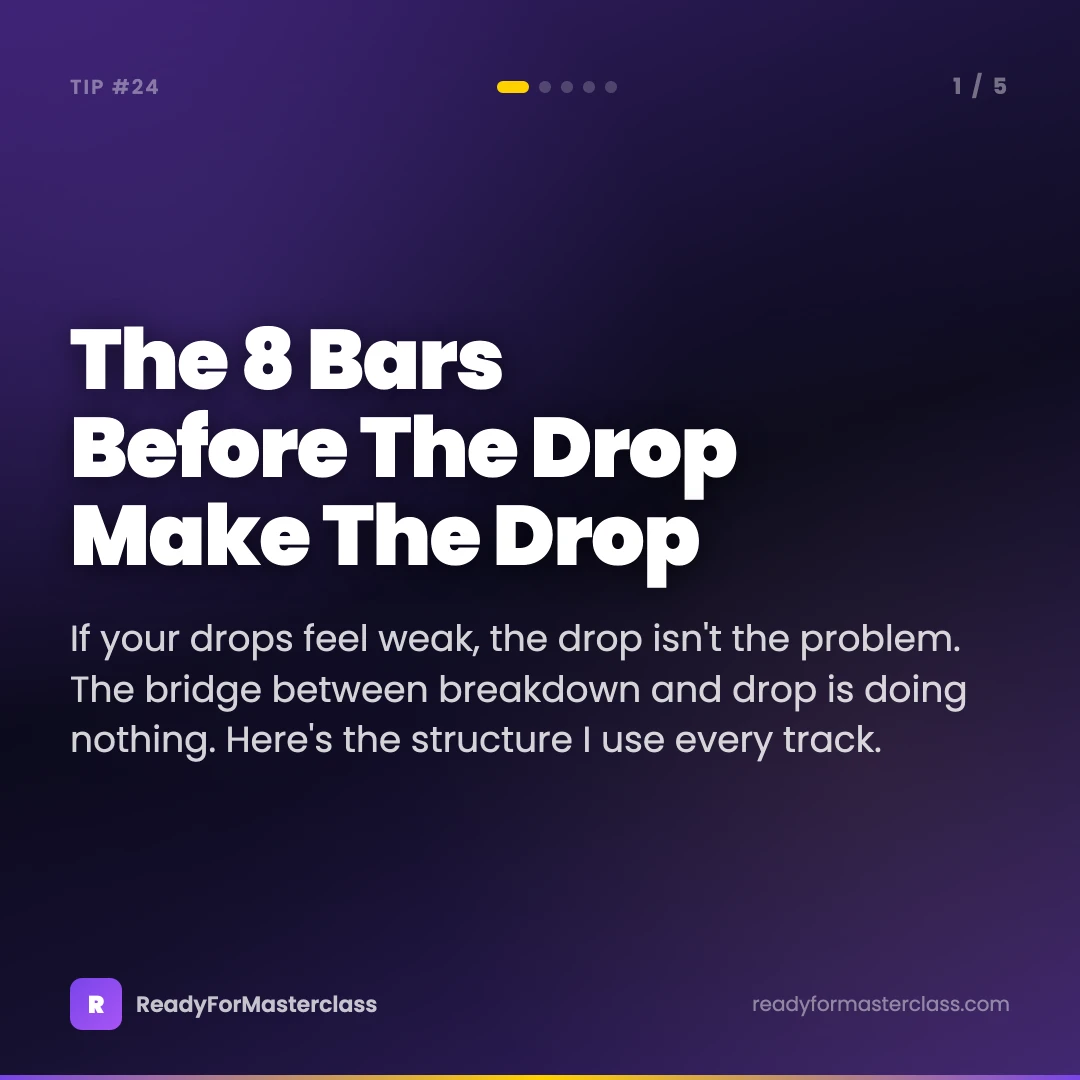
The shape of a great build
Forget the snare roll for a second. The actual shape of an 8-bar build looks like this:
- Bars 1-2: The breakdown is still going. Lead melody is still soft. You’re just starting to introduce one new element (a sub bass note, a low pulsing pad, a single kick hit on the 1).
- Bars 3-4: Drums start coming in — but only tops. Hi-hats, shakers, percussive loops. NO kick yet. The lead melody starts climbing in pitch or filter.
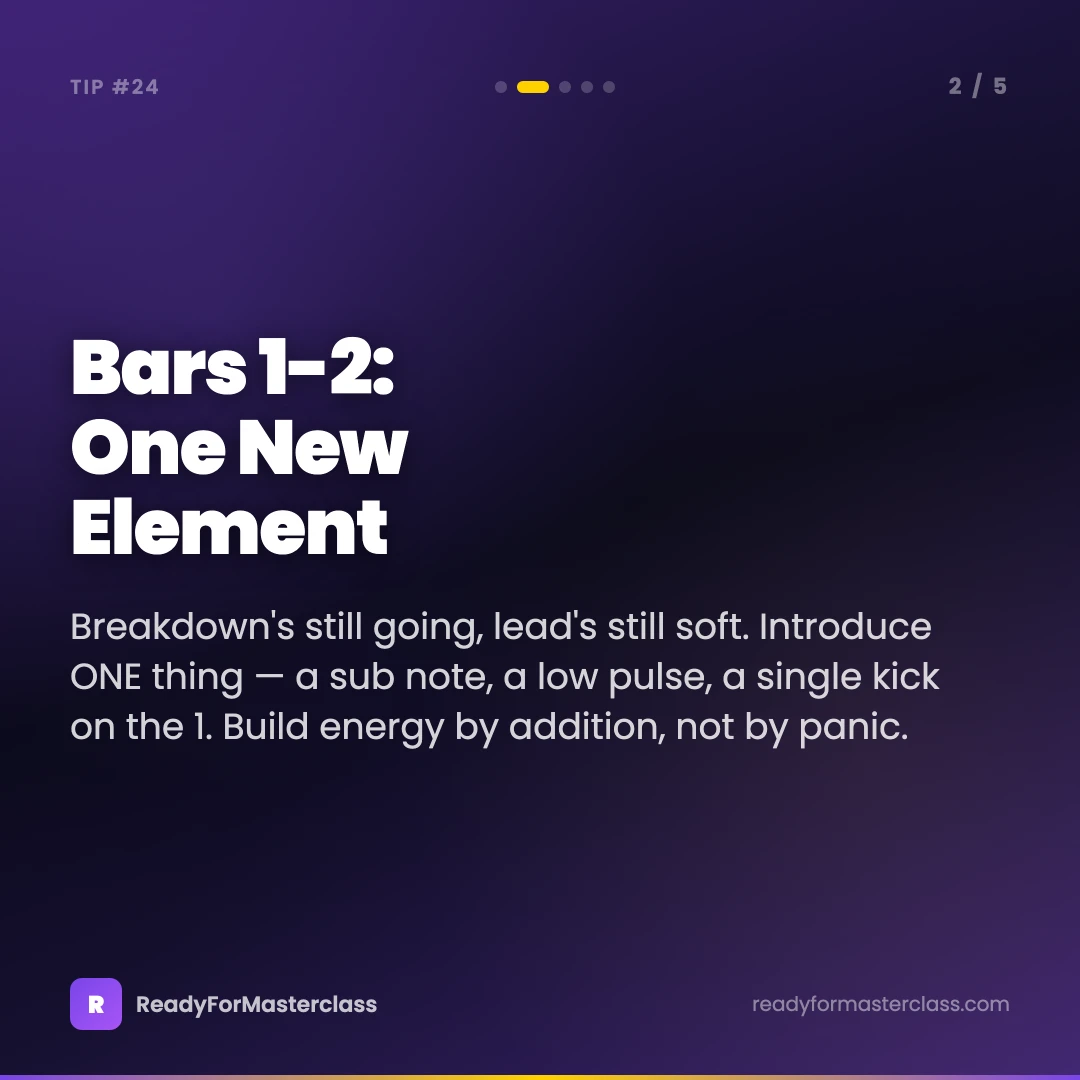
- Bars 5-6: This is where most builds skip a step. Add a counter-melody. Something rhythmic that wasn’t there before — a pluck arpeggio, a stab pattern, anything that adds a NEW musical idea, not just more energy on the existing one.
- Bars 7-8: Snare roll, riser, FX hits, white noise sweep, build automation on the lead. Everything you’ve got.
Then on the 1 of the next bar, the kick hits and the drop begins.
The trick is that bars 5-6 introduce a new musical idea right when the listener is starting to expect the snare roll. It’s a mini-misdirection — they’re not just waiting for the drop, they’re suddenly listening to a new pattern, and THAT pattern is the one that gets cut off when the drop hits. The cut feels more violent. The drop feels harder.
The five layers nobody automates correctly
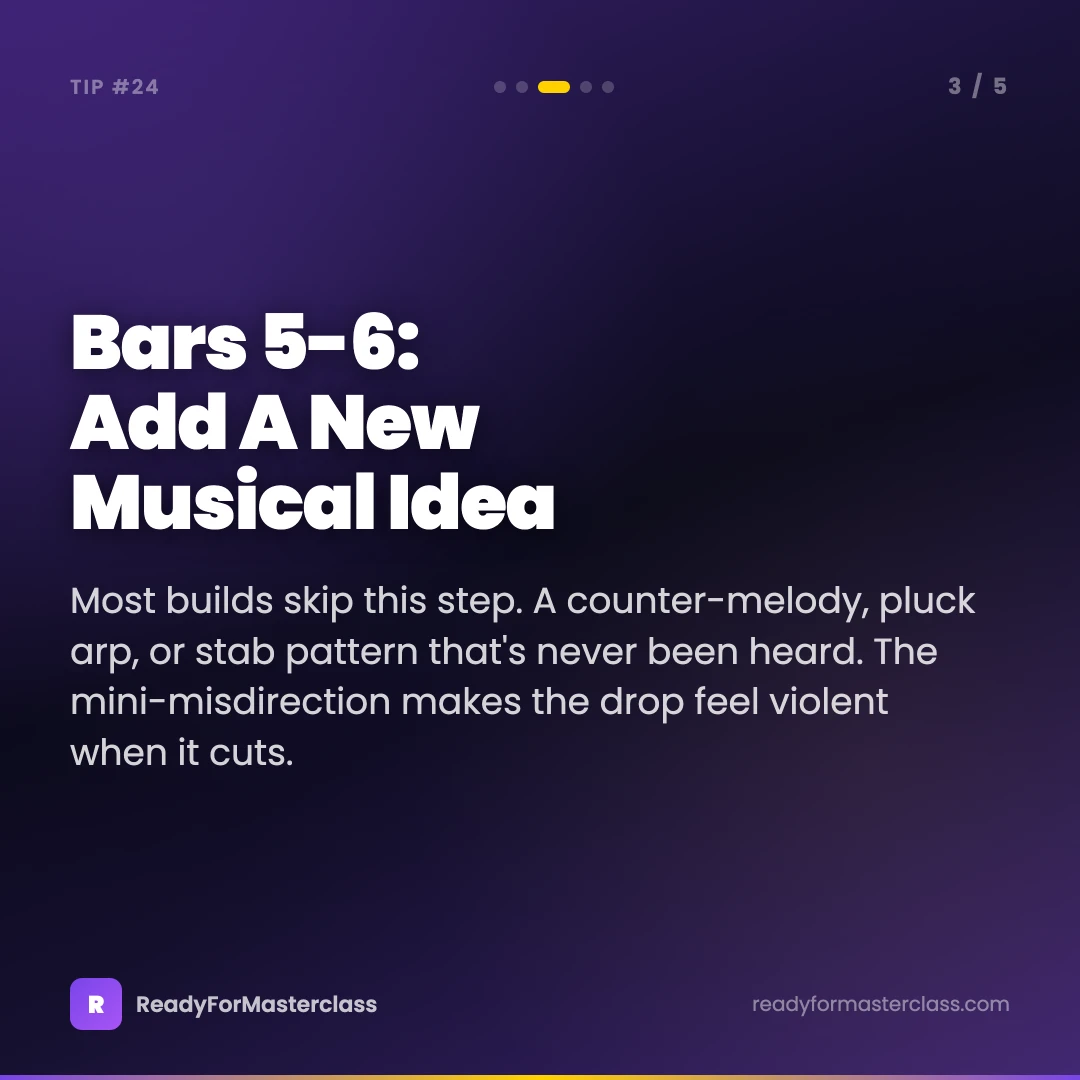
A great build isn’t a snare roll. It’s five things automating together:
- Lead melody — automate the filter cutoff opening up bar by bar. Start at 40% open in bar 1, full open by bar 7.
- Reverb send — increase the reverb send on the lead from bar 1 to bar 6, then CUT IT OFF in bar 7 (this dry-ness pulls the listener forward).
- Sub bass / 808 — fade in across bars 3-6, DROP to silence in bars 7-8 so the kick has space to hit.
- High-pass filter on EVERYTHING except the build elements — sweep upward from bar 5 to bar 8. This is the trick that makes the drop sound massive — not because the drop got louder, but because the build is now small and thin.
- White noise / atmosphere — slow upward sweep across all 8 bars.
The high-pass sweep is the one most people miss. When you progressively remove low frequencies from your build, the kick that hits on the drop sounds enormous by comparison. It’s not louder. It just has nothing competing for the bottom.
This is the kind of structural thinking I bake into every project I build, and it’s all laid out in my flagship trance template — every channel pre-routed, every send pre-set, every build automation lane already drawn so you can just drop in your own melody and the build works out of the box.
The “second build” — the secret weapon
Here’s a thing I do on bigger tracks. I build twice.
Bar 5 — peak energy. Snare roll, FX, full automation.
Bar 6 — DROP everything to almost silence except a single sustained pad note.
Bar 7-8 — SECOND build, faster, harder, snare roll doubles in speed.
The micro-drop in bar 6 resets the listener’s expectations. They thought the drop was coming on bar 7, you took it away for one bar, then you slammed them with a faster, harder build. By the time the actual drop lands on the 1 of the next bar, they’re already off-balance.
This is risky. It only works at full track energy and only on certain song shapes. Don’t put this on every breakdown. But on the second drop of an uplifting trance track, it’s lethal.
The mistake everyone makes with snare rolls
Most snare rolls in trance go: 8th notes for 4 bars, 16th notes for 2 bars, 32nd notes for 2 bars. Standard. Predictable.
Two things to do differently:
- Velocity automation. Each hit should get progressively louder. Start the roll at 60% velocity, end at 100%. Most people just use the same sample at the same volume across the whole roll, which makes the build feel flat.
- Pitch automation. Pitch the snare DOWN slightly across the roll (semitone or two). Counter-intuitive — you’d think pitching up adds tension. But pitching down adds weight, and when the kick hits on the drop it sounds even bigger by contrast.
Try it on your next track
Open a project where the drop feels weak. Don’t change the drop. Don’t change the breakdown. Just rebuild the 8 bars between them using the structure above — five elements automating, dual build with a micro-drop on bar 6, snare roll with velocity ramp.
Bounce it down. A/B against your old version. The drop will hit harder without you touching the drop.
That’s the whole secret.

P.S. — Want every channel, send, and build-automation lane already set up so you can focus on the music and not the routing? Grab my Pro Trance Template — €19.99 one-time, the actual template I start every track from.