Why Your Trance Drums Feel Lifeless (And The Layering Trick That Saves Them)
 ReOrder
·May 13, 2026
·5 min read
ReOrder
·May 13, 2026
·5 min read
You’ve got a kick that sounds great in solo. Punchy, tight, full sub. Then you put it in the mix and somehow it feels small. The track drives forward but it doesn’t pump. The energy isn’t there.
This isn’t a mixing problem. It’s a layering problem. And if you’re using a single one-shot for your kick, you’re missing 80% of what makes a real trance kick feel alive.
So let’s have a look at how I stack drums to make them feel like they’re moving, not just hitting.

The 3-layer kick stack
Every kick in my tracks is at least 3 layers. Not because more is always better, but because each layer does a job a single sample can’t do alone.
Layer 1 — Sub kick. A clean low sine pulse around 50 Hz. Tuned to the key of the track (this matters more than people think). Short — 100ms decay. Just there to give the kick a low-end push.
Layer 2 — Body kick. This is your main kick sample. Punchy, tight, tonal information in the 100-400 Hz range. This is what people think of as “the kick.” High-pass at 60-80 Hz so it doesn’t fight the sub layer.
Layer 3 — Click kick. A thin, transient-heavy sample with energy mostly above 2 kHz. Just the click of the beater. This is what makes the kick CUT through a busy mix. Without it, your kick disappears the second the lead and pads come in.
The math: each layer covers a different frequency range, so they stack without phasing or muddiness. And each one can be tweaked separately — if the kick feels weak in the bottom, you boost layer 1 without touching the click. If it doesn’t cut through the mix, you boost layer 3 without making the bottom heavier.
I cover the exact bus routing for this in my drum production reference — but the structural idea is what matters. Three layers, three jobs, never one sample doing everything.

The percussion problem
Most trance percussion is hi-hats. Maybe a shaker. Maybe a clap. That’s it.
Real movement comes from layers most producers never add:
Off-beat percussion — quick percussive hits on the AND of every beat. Wood blocks, rim shots, processed snares. Quiet (-15 to -20 dB). Just enough to add forward motion.
Pulse layer — a low-velocity 16th-note shaker or noise loop. Sidechained to the kick. This is the layer that makes the track BREATHE.
Atmosphere percussion — long, washed-out percussive hits. Gongs, atmospheric crashes pitched down 12 semitones, reverse cymbals. Sparse — every 4 or 8 bars. This is what gives long sections texture and stops them from feeling repetitive.
Transient stabs — short percussive synth hits used as transitions between sections. 1-bar fills, half-bar fills, single-hit accents at the start of new sections.
A trance track without these four layers feels mechanical. With them, it feels organic.

Sidechain compression — but not how you think
Everyone knows you sidechain bass to kick. Less people know you should sidechain percussion to kick too.
Specifically: your hi-hats, shakers, and pulse layer should ALL be sidechained to the kick — but light. Not the deep “ducking” you put on bass. Just 2-3 dB of gain reduction with a fast release.
The result: every kick hit makes the percussion duck for a fraction of a second, then recover. The track pumps without sounding pumped. It’s the secret to that “alive” feel of professional trance drums vs the rigid “computer-y” feel most bedroom productions have.
Don’t sidechain your snare or claps. Those need to hit alongside the kick, not duck under it.
Tuning — the thing nobody talks about
Drums have pitch. Even kicks. Even hi-hats.
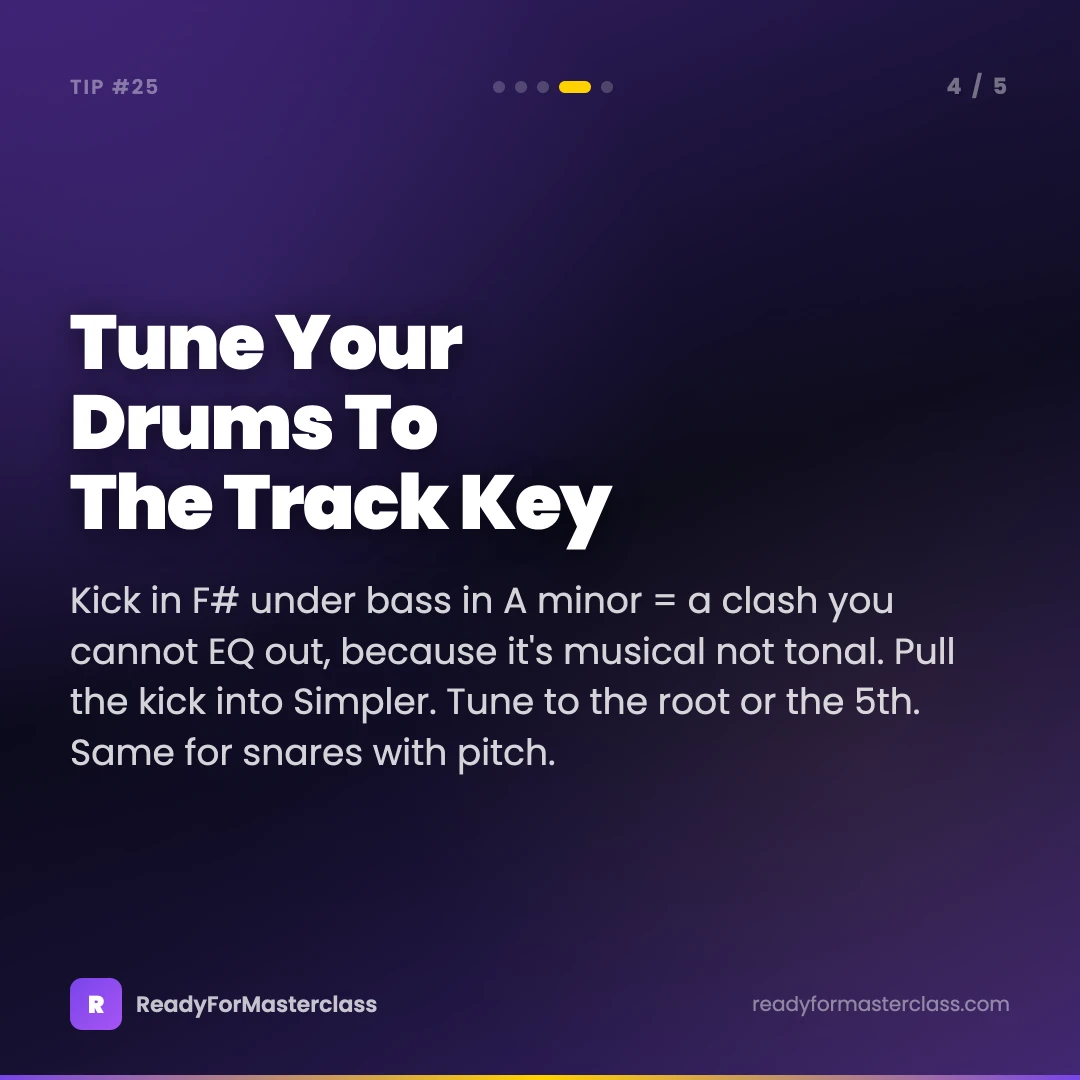
If your kick is in F# and your bass is in A minor, you’ve got a clash on the kick that you’ll never EQ out, because the problem isn’t EQ — it’s musical.
Pull your kick into a sampler (Simpler in Ableton works fine). Find the fundamental frequency. Tune it to the root of your track or to a chord tone (the 5th works great too).
Same for snares and claps if they have any pitched content. Tune them to fit the key.
This single thing made my drums feel 50% more “produced” the day I started doing it. It’s almost embarrassing how much of a difference it makes.
The mix-bus glue
Once everything is layered and tuned, route your entire drum bus through:
- Light glue compressor (2-3 dB GR, slow attack, fast release, 4:1 ratio)
- Tape saturation (subtle — you should barely hear it)
- Light EQ to taste
The glue compressor and tape saturation together fuse all your layers into one cohesive drum sound. Without that bus processing, you’ve got 8 layers playing simultaneously. With it, you’ve got ONE drum mix that hits as a unit.
Try it on your next track
Pick a track that feels mechanical. Don’t change the kick — just add a sub layer (50 Hz sine pulse, tuned to your key) and a click layer (high-passed transient sample). Add a pulse layer to the percussion (sidechained 16th-note shaker). Tune your kick.
That’s four small changes. Bounce it. Compare.
Your drums will sound twice as alive.

P.S. — If you want a complete trance starter pack with kicks, sub layers, claps, percussion loops, and FX hits all built and tuned for trance keys, the Anjuna Trance Bundle (€169.99) is the most comprehensive thing I’ve put out. Includes presets, samples, and template projects.