How To Make Plucks That Cut Through Any Mix
 ReOrder
·Jun 10, 2026
·6 min read
ReOrder
·Jun 10, 2026
·6 min read
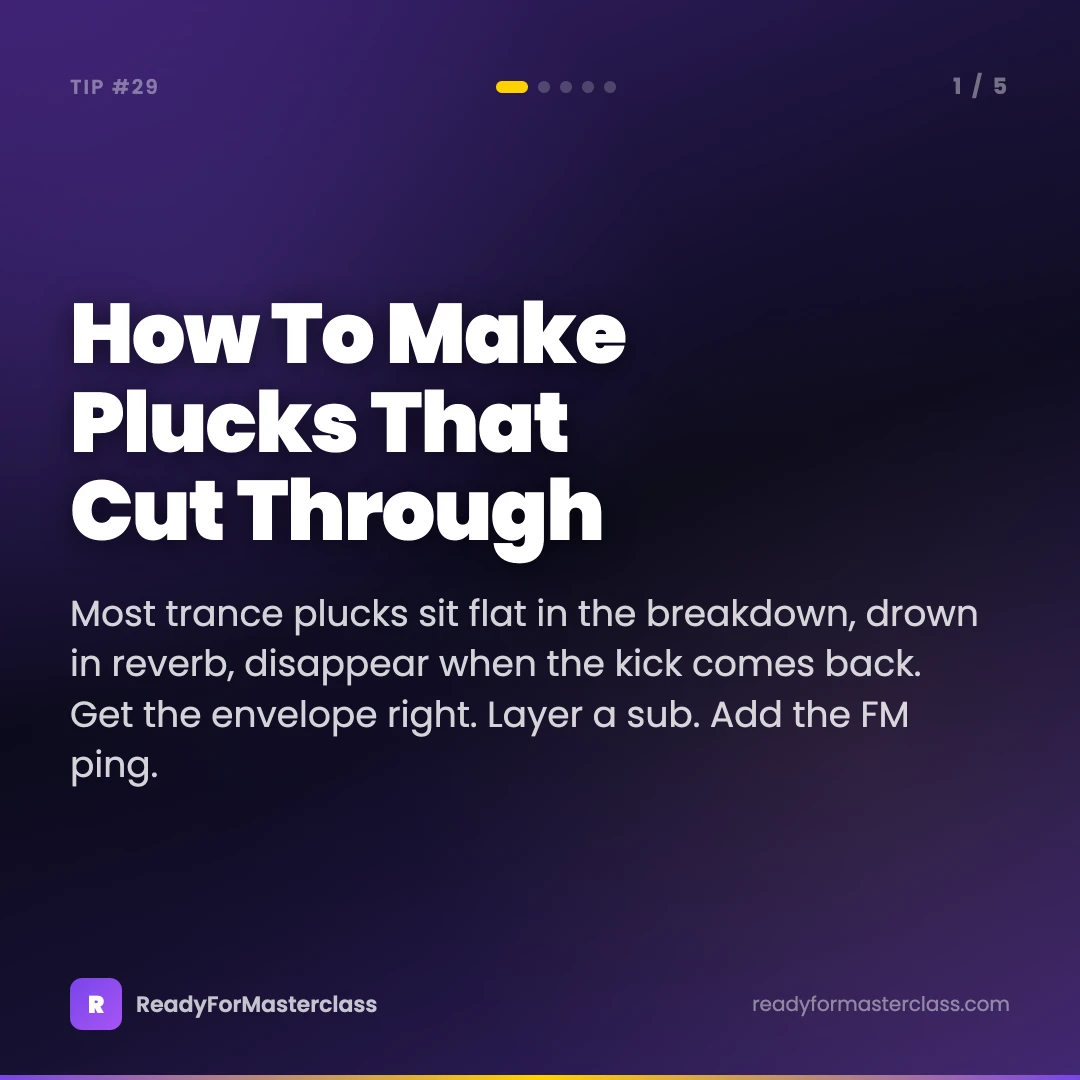
You’re working on a breakdown. You add a pluck to carry the melody under the pad. You bounce it down and the pluck just sits there — flat, lifeless, fighting with the reverb tails of everything else, getting buried in the mix the second the kick comes back in.
Most trance plucks have this problem. They’re an afterthought. People grab a default preset, load it up, drown it in reverb hoping it’ll sound interesting, and call it done.
A great pluck is one of the most useful tools in trance production. It carries breakdowns, fills space between drops, gives you a counter-melody that doesn’t compete with the lead. But you have to actually shape it. So let’s have a look at how.
What a pluck actually is
The defining quality of a pluck is its envelope. A pluck has a fast attack — almost instant — and then a fast decay where the volume drops quickly to a low level (or to nothing). The note’s life is mostly in the first 100-200 milliseconds.
That’s it. A pluck is a percussive synth note. The “pluck” sound comes from the fast amplitude curve. Same idea as a real string being plucked — the energy is at the start, then it dies away.
Most synths have a default ADSR that’s wrong for plucks. The decay is too slow, the sustain is too high. So your “pluck” patch sustains for half a second instead of dying in 100ms, which means it overlaps with the next note, which means the rhythm gets blurry and the pluck loses its punch.
Fix the envelope first. Everything else flows from there.

The ADSR settings that work
Open whatever synth you’re using. Go to the amp envelope. Set:
- Attack: 1-5 ms. Fast. The note hits immediately.
- Decay: 100-300 ms. Medium-fast. The volume drops quickly.
- Sustain: 0% to 20%. Low. After the decay, almost nothing.
- Release: 50-150 ms. Short-ish. When the note ends, it dies cleanly.
Now your synth is a pluck. The envelope shape is right.
Tweak the decay time to taste — shorter for a tighter, more percussive pluck (around 80-100 ms), longer for a more sustained “plucky lead” (200-300 ms). For breakdowns I usually want around 200ms. For drop sections where the pluck is fighting kicks and bass, I go shorter — 100-150ms — so it stays out of the way.
The FM trick that makes plucks interesting
A pluck with a clean ADSR is technically a pluck but sonically boring. What gives a pluck CHARACTER is what happens in the first 50ms — the transient.
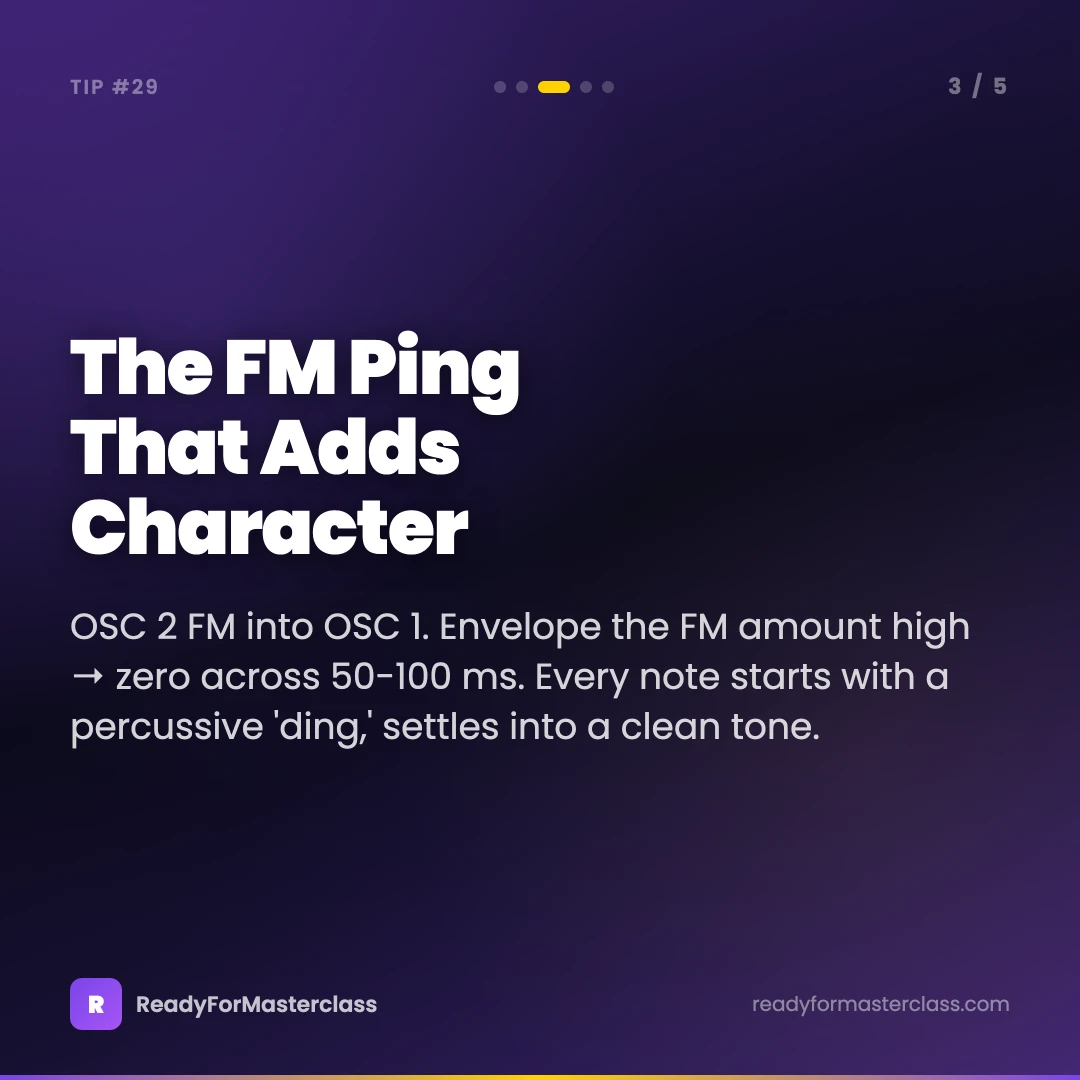
The trick: use FM (frequency modulation) on the oscillator to add a tonal “ping” at the very start of the note that fades out as the note settles.
In Spire, this is dead easy — there’s an FM section on every oscillator. Set OSC 2 to FM into OSC 1. Then automate or envelope the FM amount so it starts high (giving you a metallic “ding” at the start) and decays to zero within 50-100ms. After that initial ding, you’re left with a clean tone.
The result: every note starts with a percussive “ping” that gives it presence and clarity, then settles into a clean tail.
This is the move that takes a generic pluck and makes it sound like a producer wrote it deliberately. The Spire Plugin Mega Bundle on RFM has 200+ presets that all use this principle — every pluck patch has the FM-modulated transient built in.

Layering a sub for body
Plucks live in the upper-mid frequency range (1-5 kHz roughly). They’re meant to. But that means they have NO bottom — and a pluck without bottom will disappear under your bass and kick in the drop sections.
The fix: layer a sub-pluck underneath.
Take your main pluck patch, duplicate it. On the duplicate: – Drop the octave by 1 (or 2 for very low subs) – High-pass off above 80 Hz so it doesn’t fight your bass — wait, you want the sub. Don’t high-pass it. Instead, low-pass at 200 Hz so you ONLY hear the sub fundamental. – Keep the same envelope as the main pluck so they hit together
Now when the main pluck triggers, you get the sub layer underneath at the same time. The pluck has body. It cuts through the mix because there’s energy from low to high.
Do NOT add reverb to the sub layer. Sub + reverb = mud. Keep it dry.
The processing chain
After the synth, your pluck channel needs three things:
- High-pass filter at 200-300 Hz on the main pluck (NOT the sub layer). Plucks don’t need bass info — that’s the sub layer’s job.
- Light saturation — even just a touch of tape or tube saturation gives the pluck warmth and harmonic richness. It stops sounding digital.
- Plate or hall reverb — but specifically: short pre-delay (50-100 ms), medium decay (1.5-2.5 seconds), high diffusion. This adds atmosphere without smearing the rhythm.
Send the pluck to a separate reverb bus. Don’t add reverb on the channel directly — you want to control how much wet signal there is independently of the dry. In a busy section, mute the wet bus. In a sparse breakdown, push the wet bus up.
The “sidechain to lead” trick
If your pluck is a counter-melody under your lead, sidechain the pluck to the lead with a fast attack, fast release, and 2-3 dB of gain reduction.
What this does: every time the lead plays a note, the pluck momentarily ducks under it. The lead becomes the focus. The pluck becomes the background motion. Without the sidechain, both are fighting for the same airspace and the listener doesn’t know what to focus on.
Use a fast release (around 80-150ms) so the pluck pops back up between lead notes. Without that pop-back, the pluck just sounds quieter overall — you want it ducking and popping, not just turned down.
Try it on your next breakdown
Open a project with a breakdown that feels empty. Build a pluck patch with the ADSR settings above. Add the FM ping in the first 50ms. Layer a low-passed sub copy. Send to a short plate reverb at 30% wet.
Write a counter-melody under your lead. Sidechain the pluck to the lead.
Bounce. The breakdown will feel twice as full and twice as professional. The pluck won’t fight the lead, won’t disappear in the mix, and will give the listener something to feel between the held lead notes.

P.S. — If you want a complete pluck preset library that already has the ADSR, the FM transient, and the layered sub built in, the Spire Plugin Mega Bundle is €104.99 — 200+ trance presets including dozens of pluck patches you can drop straight into your tracks.