Three Types Of Risers That Make Builds Feel Massive
 ReOrder
·Jun 17, 2026
·6 min read
ReOrder
·Jun 17, 2026
·6 min read
You’re building up to a drop. You drag a white noise riser sample onto the timeline. You ride the volume up. You bounce it down and the build feels okay — but it doesn’t feel MASSIVE. It feels like every other build you’ve ever done. Polite. Predictable. The drop arrives without that physical shove that makes a listener actually react.
The problem is you’re using one type of riser. The producers whose builds feel enormous are stacking three different types of risers, each doing a job the others can’t do alone.
So let’s have a look at what the three types are, what each does, and how to layer them so your build feels like the room is being pulled apart before the drop hits.

Type 1: The filter sweep riser
This isn’t a sample. It’s an effect on existing material in your build.
Take any layer that’s already playing through the build — a pad, a sustained synth note, a reversed cymbal loop. Put a low-pass filter on it. Automate the cutoff frequency from low (around 500 Hz) to fully open (20 kHz) over 4-8 bars.
What this does: the listener has been hearing this sound the whole build. As the filter opens, they hear MORE of it — more high-end energy, more presence, more harmonics. The sound is the same sound, but it’s getting brighter, sharper, more aggressive. By the time the filter is fully open at the start of the drop, the listener’s ear has been pulled into a tense, top-heavy frequency space.
This is the most subtle of the three risers and also the most powerful. It works on the listener subliminally — they don’t consciously notice “a riser is happening,” they just feel the energy ramping up in something they were already paying attention to.

Type 2: The white noise riser
This is the one everyone uses. White noise + envelope automation = riser. You hear it in every commercial trance track.
But there’s a way to use it that 90% of producers miss.
Don’t just drop a white noise sample on the timeline and call it done. Build the riser yourself:
- Generate white noise (most synths have a noise oscillator, or use a noise plugin)
- Put a band-pass filter on it
- Automate the band-pass filter’s center frequency from low (200 Hz) to high (8 kHz) across the riser
- Automate the volume from -infinity to 0 dB across the same span
- Add a slow stereo widener that opens up as the riser progresses
What this does: instead of a flat, undifferentiated white wash, you get a SWEEP. The frequency content moves upward as the volume rises. The stereo image expands. By the end, you have a wide, bright, full-spectrum white noise — the textbook “riser” sound — but it arrived there with motion instead of just appearing.
Better than a sample. More interesting, more controllable, more your own.

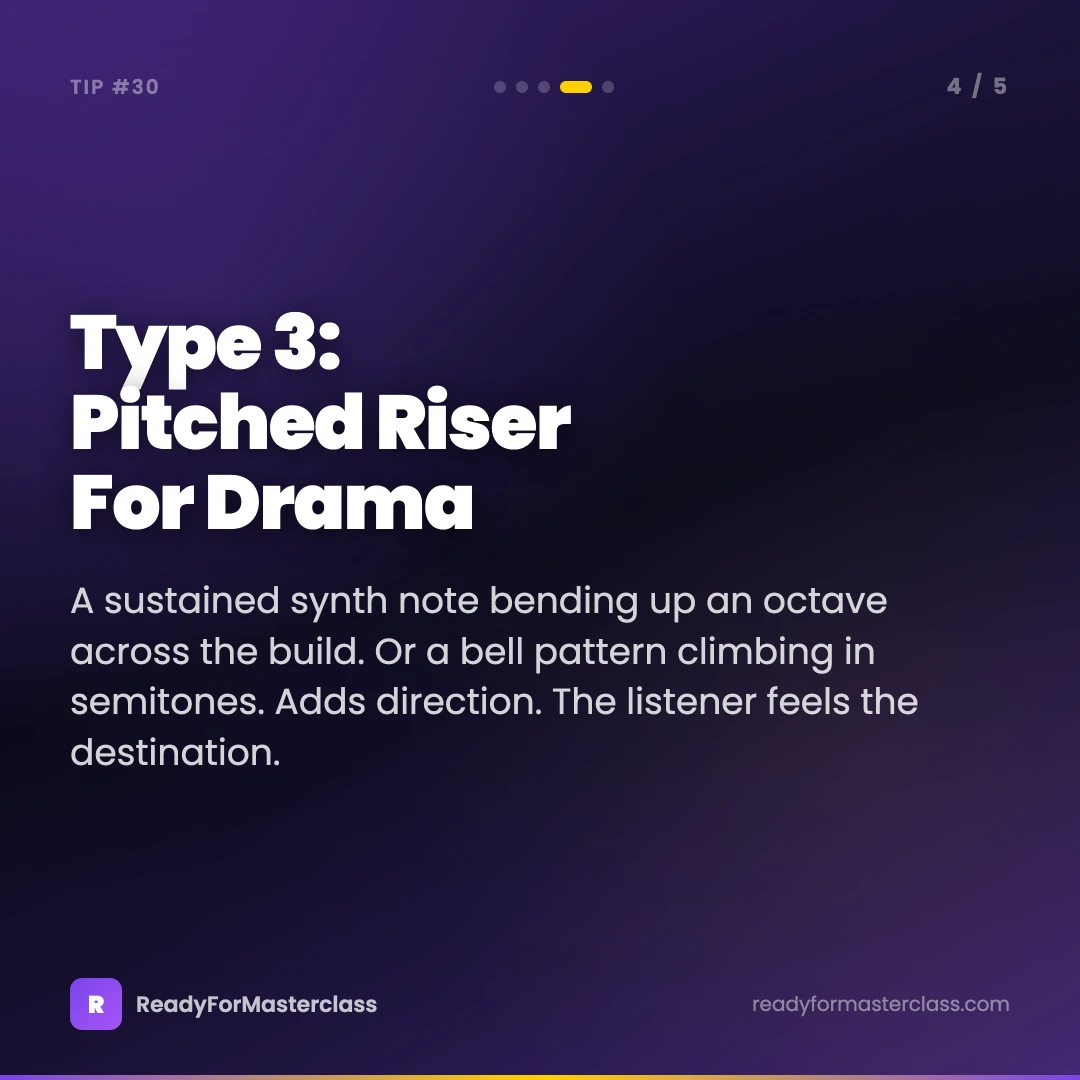
Type 3: The pitched riser
This is the one that adds DRAMA. A tonal element that climbs in pitch across the build.
Take a synth — saw, square, anything with character. Play a sustained note. Automate the pitch upward across the riser, usually a full octave or more. Add a long delay or reverb to thicken it.
In trance, the classic version is a sustained note that slowly bends upward. You can also do it as a discrete climb (whole step, whole step, half step) if you want something more melodic and less “builds-eyes-up-for-effect.”
What this does: the pitched riser introduces a clear melodic intent. Where the white noise gives you texture and the filter sweep gives you brightness, the pitched riser gives you DIRECTION. The listener feels a specific destination — the high note at the end of the climb. Their ear is dragged toward it.
You can also do this with a synth bell or pluck, played repeatedly with each repetition pitched higher, getting faster as the riser approaches its peak. That’s the “Above & Beyond” build trick. Lethal in the right context.
The ReOrder Producer Sample Pack Bundle on RFM has dozens of pre-built risers across all three types — you can drag them onto your timeline and they’re ready to layer immediately. €59.99 for the whole bundle, including FX hits, snare rolls, and atmospheres.
How to layer all three
This is where the magic happens. Don’t pick one — use all three at once.
Here’s the structure:
Bars 1-4 of the build (bars 5-8 of an 8-bar build): Filter sweep on existing material starts opening up. White noise is below audibility. Pitched riser hasn’t started yet.
Bars 3-4: White noise enters at low volume, band-pass at 500 Hz, slowly automating up. Filter sweep continues opening.
Bars 5-7: Pitched riser enters with the melodic climb. White noise is more present and brighter. Filter sweep is mostly open.
Bar 8: Everything peaks. Filter is fully open, white noise is at max volume and max width, pitched riser hits its top note.
Bar 8.5 (the half-bar before the drop): Cut everything to silence except a single sustained pad note. The micro-pause before the drop. (See Tip 24’s 8-bar build breakdown for why this works.)
When the kick hits on bar 1 of the next phrase, the contrast is enormous. The listener has been ramped up by three independent ascending elements, then yanked into silence for half a bar, then slammed by the drop.
That’s how builds feel massive. Not because any one element is louder, but because three different layers are independently raising the energy and your ear can’t focus on any single one of them.
A common mistake — the snare roll alone
A snare roll is not a riser. A snare roll is a rhythmic element ON TOP of risers. It tells your ear “the drop is coming in this many bars.” It gives you a tempo-locked countdown.
Risers are the energy. Snare rolls are the timing.
If you’re trying to build energy with snare roll alone, you’ll always sound flat. Snare rolls are a percussion element. Risers are FX. Use both. Don’t substitute one for the other.
Try it on your next build
Open a project with a build that feels weak. Don’t change the kick, don’t change the drop. Just rework the build:
- Pick a sustained element already in the track. Add a filter automation that opens across the whole build.
- Build a custom white noise riser using band-pass + volume automation.
- Add a pitched element — a synth note bending up an octave, or a pluck climbing in semitones.
- Cut everything for half a bar before the drop.
Bounce. Compare. The drop will feel twice as massive without you touching the drop.

P.S. — If you want a stack of pre-built risers, snare rolls, FX hits, and atmosphere samples I use in my own tracks, the ReOrder Producer Sample Pack Bundle is €59.99 — drag-and-drop ready, organized by type and energy level.